Long, centrally issued, earmarked
Expert №29 (952)
AlexandrIvanter
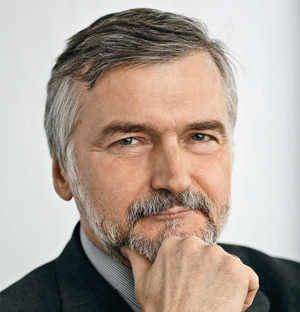
Deputy Chairman, chief economist
Member of Vnesheconombank Management Board Andrei Klepach
The Central Bank should be more active in using non-traditional refinancing methods to buy out project bonds of banks and development institutions issued against specific investment projects and then block unlawful diversion of funds through using regulatory methods
Exactly a year ago, Andrei Klepachleft his post of Deputy Economic Development Minister. In total, he worked for the Economic Development Ministryten years and earned a reputation of one of the best in the country applied macroeconomists. Prior to this, he was a research scientist: after graduating from the Economics Department of MGU in 1981, he worked for ten years at the Political Economics Department of his alma mater and defended his thesis. Then he worked at the Institute of National Economic Forecasting and Nongovernmental Analytical Development Center.
His intelligent manners, soft voice, observant eyes - all features of a scientist- are still with him. But they shouldn’t mislead you. As far as principles and convictions are concerned, he is a tough and straightforward person. In discussions and in bureaucratic apparatus battles on key issues of economic policy of at least the past ten years Klepach has been a firm proponent of stepping up the state’s role in economy and reviewing the dominant paradigm of fiscal and monetary restraints.
Although in his capacity of the Deputy Chairman, the chief economist and the member of Vnesheconombank Management Board Andrei Klepach keeps on analyzing and forecasting economic situation, was caused by Andrei Klepach got somewhat more freedom in evaluating economic policy of the Central Bank and the Government and this was an additional impetus for conductingthis interview. While working in his new position for several months and immersinghimself in the inner workings of the bank for development he still can take a fresh look at things as an outsider.So, his opinion about some sensitive issues of VEB’s operation are also very interesting. But we started talking about the current economic situation.
-Andrei Nikolayevich, a monthly monitoring of Russian GDP you are responsible for at VEB shows a deeper economic downturn and a change in economic profile. Could you comment in agreater detail?
-If average year on year oil price is about 60, a fall in GDP will be about minus 3.5-3.8 percent.
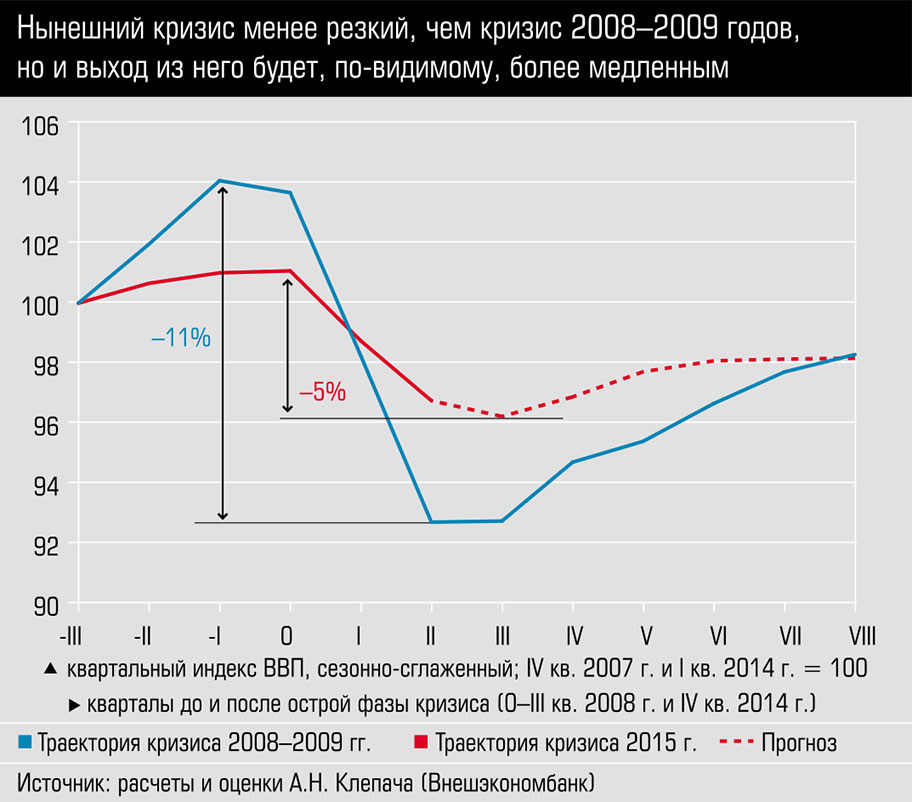
As to the downturn’s profile, we can see thatit is less sharp than during the last crisis seven years ago but it will take us longer to overcome it if we do not take incentive measures. It shows many differences from the 2008-2009 crisis. The previous crisis was a part of the world’s crisis but the current one is developing against the backdropof accelerated growth of the global economy, atleast its key economic zones with the exception of China. The current crisis in our country was caused by a number of circustances.Above all, it was a sharp and deep fall in oil prices plus the effect of sanctions that cut off access to main foreign capital markets and increased capital outflow. Demand contraction is stronger today. Reduction of stocks played a crucial role in the previous crisis. In the current crisis, there isn’t such excessive accumulation of stocks and their reduction is caused to a large extent by reduction in imports.
In other respects many differences can be also seen. As to consumer demand dynamics and retailing we are experiencing a much more serious setback than at the time of the previous crisis. As awhole on a year on year basis retail business may drop by 8.5-9 percent. And it is clear why. As opposed to the situation in 2008-2009, real personal incomes fell dramatically. They didn’t let it happen thenby raising pensions and wages of budget workers.
-The increased social spending in 2008-2009 was in fact the main anti-crisis measure. It maintained social stability in the country. And liberal economists are happy about such a measure because social spending is less susceptible to corruption. Why doesn’t the state resort to this time-tested method? Don’t we have financial resources or is this a principal political decision?
— Wages in the budget sector kept on rising even after the previous crisis was over in the course of implementing the May 2012 presidential decrees. It is to a large extent a long-term social, strategically relevant maneuver.We may have gone too far. Wages increased faster than our capabilities.Now, we are rolling backhere. Decisions haven’t been taken yet but the Finance Ministry argues for minimizing wage indexation in the 2016-2018 federal budget. In real terms incomes of budget workers and pensioners have already diminished in the pastyear and they will diminish significantly in the current year and it will take several years to compensate for this downturn. Is this reasonable?The fact is that budget workers and pensioners form a substantial part of consumer demand. I think we have to find an optimum balance. It’s also very important that rise in labor productivityshould not lag behind rise in wages but it’s next to impossible to make it happen, if a structural maneuver in favor of budget workers continues.
So far, a significant rise in wages in the budget sector in 2009-2014 did not result in a relevant increase in volumes and quality of services provided in public healthcare and education systems. But given reduced incomes, most people cannot transfer to paid medicine and education. In fact, people have to economize on their healthand their family members’ level of education.
-And how do matters stand in the investment sector?
-The situation with investments today is more complicated and sharper than in the previous crisis. According to our estimates, investments infixed capital in 2015 will shrink by about 15 percent, earlier we expected even a larger reduction of 19 percent. The contraction in consumer demand and retailing occurred for the most part in the first quarter and in April, in the future, taking into account a seasonal factor,a secontraction discontinues and in the third quarter, we are most likely to see insignificant growth (but on year on year basis there will be a negative growth).
A situation with investments is exactly the opposite. The first quarter is not informative here. Major investments are made at year-end and only at that time,we’ll be able to see an extent of investment gap. Government investments contract much more strongly than private ones. This is true of both federal budget andregional ones.
Exports and defense industry support industrial sector
-The industrial sector showed a good dynamics until March-April. In contrast to a sharp drop in industrial output in the second half of 2008, industrial output remained in plateau for several months taking into accounta seasonal factor. Against the backdrop of crisis enclaves in construction materials manufacturing and transport mechanical engineering we saw an import substitution growth in food processing sector, smelting and chemical industries. And in May, data showed that the situation had worsened in the industrial sector. What is going on there?
-The situation in the industrial sector is still substantially better than in 2008-2009, above all due to export sectors (the ruble’s devaluation played a positive role despite still low prices for crude oil and raw materials. And today, Russia’s defense industrial complex supports the dynamics of mechanical engineering and entire industrial output. And this year as a whole our economy will be supported by agriculture: I hope it will show growth, harvest prospects are good. Moreover, government measures for subsidizing agricultural producers’ costs both interest and to a lesser degree investment ones.
At the same time, downturn in capital investments severely affects producers of smelting products, machines and equipment, construction materials. Moreover, in a number of industrial sectors and above all in automotive and railcar manufacturing industrieswe can see a clear-cut structural rather than a market condition crisis. The railcar market is glutted and auto cars are not sold out against the backdrop of a sharp fall in family incomes and even a nominal contraction in consumer credit.
A dramatic situation withconsumer credit is a serious brake not only on the consumer market but also on the investment one. According to our andSMASF’s (the Center for Macroeconomic Analysis and Short-Term Forecasting) estimates in a number of industrial sectors enterprises spend up to a half of their profits and even more on servicing their debts. In fact, industrial sectors are working for banks to survive. Under these conditions, there is a need for not purely market-based support measures. Vnesheconombank’s role is very important here. Our Bank’s proportion in national corporate lending is 7 percent and in long-term lending – 13 percent. In contrast to commercial banks, VEB didn’t raise credit rates so sharply in winter under ongoing agreements and keeps on lending to enterprises at ratessubstantially lower that mid-market ones, in fact, at a loss.
We have to think how to recoup these losses because foreign capital markets are closed for VEB under the conditions of sanctions. In this situation the state has to additionally capitalize VEB and cover its losses. And it has to do it not for the sake of Bank itself but for VEB to continue performing its long-term stabilizing role in the investment process. So far VEB has received 30 billion rubles but an issue of how they should be used to cover losses hasn’t been resolved.
A principal decision was taken to invest financial resources of the National Wealth Fund worth 300 billion rubles through VEB. But it’s very important to select projects and launch their support as soon as possible. It’s very important that the next should not be lost for investments. It’s extremely difficult to close the investment gap. There is a need or projects that would create jobs and demand inside the country and would focus on import substitution rather than on importation of technologies.
The Central Bank is a source of long money
-In the current year, investment resources gap in the economy will reach 1400 billion rubles and capital outflow will amount to 90-100 billion dollars. What could close this gap?
-We’ll have to resort to a much wider use of the National Wealth Fund’s financial resources if we are not to get stuck in this investment pause for another several years.Essentially, neither the National Wealth Fund nor budgetary resources are capable of resolving an issue of supplying long money in the economy. I think that the Central Bank should be more active in using non-traditional methods of refinancing investment projects. A move that the Central Bank made as part of project finance mechanism is not in line with the need both in terms of the procedure that is now too complicated and in terms of transactions limits: 50 and even 100 billion rubles areinsignificant amounts in a macroeconomic sense.And the mechanism used under resolution on project finance number 1044 is of bureaucratic rather than banking nature.
I think it would be more appropriate if the Bank of Russia buys at a preferential rate, bonds issued by VEB, other banks and development institutions in order to fund investment projects. At the same time, the Central Bank will have to use monitoring and supervision instruments toblock unlawful diversion of funds for this small number of banks for example by committing these funds to the foreign exchange market. Moreover, at least as far as VEB and Rosselkhozbank is concerned. The Central Bank couldregulate a marginal rate for end-use borrowers and set indicative ceilings for desirableincrements of loan portfolio. The need for such preferential funding is at least 500-700 billion rubles per year.
-From the Central Bank management point of view, you are suggesting an absolute sedition. You are proposing to change the paradigm of money supply in the country and launch a rubble emission with managedinflationary risks.Are you well aware of it”
-If we want to achieve a real breakthrough in the economic dynamicswe should do these particular things, rather than reassuring ourselves by talking about improving investment climate and judicial system. We need all this but now we have to deal with a situation of shock, crisis and sanctions. We need a pretty powerfultherapeutic intervention and not a surgical one so far in order to reverse the situation with investments.
To my mind, there is also another problem, which is underestimated by the state. Today, we have to additionally capitalize not only the banking sector but also many system-forming sectors in the real economy. They came out of the 2009 crisis still limping along and many of them sustained new losses and accumulated new debts. Here I mean aviation industry, engine building and space industry. Market-based recovery is not possible, given the current banking interest rates of 14-17% per annum. A decision was takenthat the state would provide JSC United Aircraft Corporation with 100 billion rubles. But all this money will go to banks. In the coming years civil aviation industry will generate losses until such key projects as SSJ100 and MS-21 become profitable. But it would be short-sighted to stopor freeze these projects because we’ll lose this sector and will be left with debts alone. So, we should continue investing money with a view to a loan repayment horizon of seven-ten years. We could do through Vnesheconombank using financial resources of the National Wealth Fund. The money is sure to return- this is not a black hole.
VEB is a foreman of industrial policy
-In 2014, VEB posted a shocking consolidated loss of 250 billion rubles.The main reasons are allocations to reserves under the Bank’s Olympic and Ukrainian projects, negative revaluation of bonds. We’re getting an impression that the Bank ruptured itself under the burden ofmany money-losing political projects. Two years ago started to make efforts to develop procedures for working with special projects including a procedure to compensate for the Bank’s losses by the state under such projects. You even discussed the introduction of quotas to fix a maximum annual amount of VEB’s administered projects. How is this work going on?
-Now special projects account for about a third of VEB’s loan portfolio. These are projects with increased risks, repayment and service problems. But it doesn’t mean that other projects without such a formal status are not problematic. It’s difficult to draw a clear-cut line here. In VEB’s development strategy up to the year 2020, we proceed from the premise that strategically our loan portfolio will grow as a result of funding more market-oriented projects rather than special ones. Repayability of loans is a necessary requirement for special projects.
-I believe that for VEB to be able to focus on long-term priorities in its credit policy and significantly reduce the amount of work received from the state on special projects there is a need for a fundamental managerial reform. Today,the Chairman of Vnesheconombank is appointed by the President on the recommendation of the Prime Ministerand the Prime Minister himself becomes ex officio Chairman of the Bank’s Supervisory Board. It’s a very rigid structure, which in fact transforms VEB into a financial SPV of the government without veto power by definition. Maybe, VEB needs to raise a degree of its operational independence. Not of course to a level of the Central Bank. What do you think on this account?
-If we look at foreign development banks business experience, their organizational-managerial connection with the government is not so strong than in the case with Vnesheconombank and they are less dependent.But as far as lines of lending are concerned their national governments order development banks what to do in a much more rigid way. Vnesheconombank current memorandum is rather diluted and it allows to finance almost everything. So, it’s more important for VEB to focus more on selecting lines of lending in accordance with government industrial policy priorities and get involved more actively in implementing and even developing government programs as wellas funding strategic projects under these programs rather than reform its managerial model.
Back
[Bitrix\Main\DB\SqlQueryException]
Mysql query error: (1290) The MySQL server is running with the --read-only option so it cannot execute this statement (400)
REPLACE INTO b_iblock_section_iprop (IBLOCK_ID, SECTION_ID, IPROP_ID, VALUE) VALUES ('4', '7290', '80', 'News')
/var/www/veb/data/www/veb.ru/bitrix/modules/main/lib/db/mysqliconnection.php:137
#0: Bitrix\Main\DB\MysqliConnection->queryInternal(string, array, NULL)
	/var/www/veb/data/www/veb.ru/bitrix/modules/main/lib/db/connection.php:330
#1: Bitrix\Main\DB\Connection->query(string)
	/var/www/veb/data/www/veb.ru/bitrix/modules/iblock/lib/inheritedproperty/basevalues.php:224
#2: Bitrix\Iblock\InheritedProperty\BaseValues->insertValues(string, array, array)
	/var/www/veb/data/www/veb.ru/bitrix/modules/iblock/lib/inheritedproperty/sectionvalues.php:146
#3: Bitrix\Iblock\InheritedProperty\SectionValues->queryValues()
	/var/www/veb/data/www/veb.ru/bitrix/modules/iblock/lib/inheritedproperty/basevalues.php:104
#4: Bitrix\Iblock\InheritedProperty\BaseValues->getValues()
	/var/www/veb/data/www/veb.ru/bitrix/components/bitrix/news.list/component.php:276
#5: include(string)
	/var/www/veb/data/www/veb.ru/bitrix/modules/main/classes/general/component.php:594
#6: CBitrixComponent->__includeComponent()
	/var/www/veb/data/www/veb.ru/bitrix/modules/main/classes/general/component.php:653
#7: CBitrixComponent->includeComponent(string, array, NULL)
	/var/www/veb/data/www/veb.ru/bitrix/modules/main/classes/general/main.php:1037
#8: CAllMain->IncludeComponent(string, string, array)
	/var/www/veb/data/www/veb.ru/local/templates/.default/components/bitrix/news/press-tsent/bitrix/news.detail/.default/template.php:288
#9: include(string)
	/var/www/veb/data/www/veb.ru/bitrix/modules/main/classes/general/component_template.php:720
#10: CBitrixComponentTemplate->__IncludePHPTemplate(array, array, string)
	/var/www/veb/data/www/veb.ru/bitrix/modules/main/classes/general/component_template.php:815
#11: CBitrixComponentTemplate->IncludeTemplate(array)
	/var/www/veb/data/www/veb.ru/bitrix/modules/main/classes/general/component.php:735
#12: CBitrixComponent->showComponentTemplate()
	/var/www/veb/data/www/veb.ru/bitrix/modules/main/classes/general/component.php:683
#13: CBitrixComponent->includeComponentTemplate()
	/var/www/veb/data/www/veb.ru/bitrix/components/bitrix/news.detail/component.php:438
#14: include(string)
	/var/www/veb/data/www/veb.ru/bitrix/modules/main/classes/general/component.php:594
#15: CBitrixComponent->__includeComponent()
	/var/www/veb/data/www/veb.ru/bitrix/modules/main/classes/general/component.php:653
#16: CBitrixComponent->includeComponent(string, array, object)
	/var/www/veb/data/www/veb.ru/bitrix/modules/main/classes/general/main.php:1037
#17: CAllMain->IncludeComponent(string, string, array, object)
	/var/www/veb/data/www/veb.ru/local/templates/.default/components/bitrix/news/press-tsent/detail.php:70
#18: include(string)
	/var/www/veb/data/www/veb.ru/bitrix/modules/main/classes/general/component_template.php:720
#19: CBitrixComponentTemplate->__IncludePHPTemplate(array, array, string)
	/var/www/veb/data/www/veb.ru/bitrix/modules/main/classes/general/component_template.php:815
#20: CBitrixComponentTemplate->IncludeTemplate(array)
	/var/www/veb/data/www/veb.ru/bitrix/modules/main/classes/general/component.php:735
#21: CBitrixComponent->showComponentTemplate()
	/var/www/veb/data/www/veb.ru/bitrix/modules/main/classes/general/component.php:683
#22: CBitrixComponent->includeComponentTemplate(string)
	/var/www/veb/data/www/veb.ru/bitrix/components/bitrix/news/component.php:216
#23: include(string)
	/var/www/veb/data/www/veb.ru/bitrix/modules/main/classes/general/component.php:594
#24: CBitrixComponent->__includeComponent()
	/var/www/veb/data/www/veb.ru/bitrix/modules/main/classes/general/component.php:653
#25: CBitrixComponent->includeComponent(string, array, NULL)
	/var/www/veb/data/www/veb.ru/bitrix/modules/main/classes/general/main.php:1037
#26: CAllMain->IncludeComponent(string, string, array)
	/var/www/veb/data/www/veb.ru/en/press-center/index.php:6
#27: include_once(string)
	/var/www/veb/data/www/veb.ru/bitrix/modules/main/include/urlrewrite.php:159
#28: include_once(string)
	/var/www/veb/data/www/veb.ru/bitrix/urlrewrite.php:2