Trajectory of the Ruble
RG-Business №930
January 14, 2014
Natalya Baranovskaya
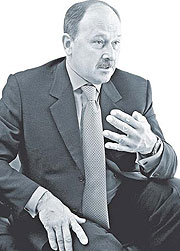 A decision is to be made in January to additionally capitalize Vnesheconombank with 200 billion rubles through using monetary resources of the National Wealth Fund. This will make long money a lot more available for funding capital investments. The Bank’s Chairman Vladimir Dmitriev told the Russian Business Gazette about investment policy priorities of the Bank for Development and Foreign Economic Affairs.
-Vladimir Alexandrovich additional capitalization of Vnesheconombank generates interest both among professionals and a wide range of readers. Is this a matter of enhancing the Bank for Development?
-You are quite right. But let’s start from scratch. In terms of long-term credits volume in relation to its own capital VEB ranks first among Russian banks. VEB raises borrowed funds and organizes co-financing of projects jointly with other investors. This makes it possible to fund investments through the Bank for Development rather than through direct budgetary funding.
But at the start of the last year Vnesheconombank reached lending volumes scheduled under the current Strategy for the start of 2015. The loan portfolio of the Bank for Development (not included the funding of anti-crisis measures and rehabilitation projects) as of January 1, 2013 amounted to 720 billon rubles, with the target indicator being 531 billion rubles. The Bank reached its limit in terms of capital adequacy. Capital adequacy ratio was 10.9% as of July 1, with minimum permissible ratio being 10%.
And we should take into account the fact that VEB differs from many foreign banks for development. There are numerous examples when foreign banks for development were additionally capitalized through using government funds. For example, in 2010 capital of the Brazilian Development Bank BNDES was increased by 2.5 times through using government budgetary funds. In Germany the development bank’s borrowings are based on state guarantees but VEB relies on market funding including borrowings abroad.
And another principal factor. VEB is regularly engaged for supporting projects of national significance and these projects are not standard and typical for the Bank for Development. We get into situations when we have market liabilities and have to deal with non-market assets. Combining these functions led to the need to expand VEB’s funding base. Additional capitalization of the Bank for Development is a task that should be addressed promptly.
-What amounts of money do you mean?
-The Bank’s capital should be increased by hundreds of billions of rubles and this will make it possible to make long money more available for funding capital investments. On the other hand additional capitalization should be accompanied with improving the business model and changes in credit process. The Government is close to making a decision on this issue.
There is a proposal to divide investment projects to be accepted for funding by the Bank into two categories – typical and special projects. Typical projects are in line with our regulatory network, their risk levels and rates of return make it possible to increase loan portfolio without having negative influence on the Bank’s solvency.
Special projects are non-standard projects which are of top-priority importance for Russia’s economy and on the other hand are not in line with requirements for risks and profitability. Decisions on such projects are to be within the competence of the Bank’s Supervisory Board. It is the Bank’s Supervisory Board that will be responsible for approving objectives of VEB’s participation in a given project, limitations on the project management as well as sources of funding and compensation for the bank’s participation in the project.
-Initially, the Government proposed to transfer 500 billion rubles worth of the National Pension Fund’s new pension savings to Vnesheconombank (for temporary management). Was this initiative somehow connected with the plans to additionally capitalize the Bank for Development?
-VEB’s function as the state managing company is independent of its function as the Bank for Development. This function is separated by a Chinese wall from other lines of VEB’s activities.
-The Bank’s Strategy for 2011-2015 provides for supporting various economic sectors and regions, SMEs and national exports. What are the results of the Bank’s activity and what difficulties do you come up against?
-“Even if you have a brilliant strategy, from time to time you have to look at your performance”, Winston Churchill said. It’s true. But I’d like to say a few words about the Strategy.
Our main goal is to boost our national economy’s competitiveness and help to modernize it on an innovative basis. And in order to perform well here we have to create a favorable environment for development.
Annual labor productivity growth in Russia now is only 2-3% and this is a very serious problem. In industrialized economies labor productivity is more than two times higher than in Russia. At the same time, the Russian President has quite recently highlighted a number of regions where labor productivity growth is a lot higher than in Russia on average. The Kaluga region tops this list with 13%. As you can see the region does not live off raw materials. Its excellent performance is a result of favorable business climate and favorable conditions for raising investments and launching advanced production facilities. And our Bank, to be more precise,VEB Group is making its contribution to creating such environment.
For example, since 2008 VEB has been funding the project to develop infrastructure of the Kaluga region’s industrial parks. The Bank’s total participation share in funding the project is 11.2 billion rubles. The project is designed to create conditions for investors to deploy their new production facilities in industrial parks of the Kaluga region including engineering development of industrial sites equipped with all required infrastructure as well as construction of manufacturing and storage facilities and multi modal logistics centers. As a result, 29 new production facilities were built as of today and 16 thousand jobs were created. The total amount of investments in the region’s economy is 143 billion rubles. You must admit that it’s a good result.
Now we are jointly working on the Kaluga region’s comprehensive development. Both VEB Group and the region’s government have prepared a relevant plan. The plan involves VEB and its subsidiaries: VEB Capital, VEB-Leasing, SME Bank GLOBEX and Svyaz-Bank, the Export Insurance Agency of Russia (EXIAR).
I’d like to give you two more examples.
The oil products transshipment terminal at the marine trade port of Ust-Luga is one of the Bank for Development’s largest infrastructure projects. Up to 30 million tons of oil products are to be transported through this terminal per year. In September of 2013, the Bank completed its participation in this project. Payment obligations of the project initiator and borrower – Rosneftbunker to Vnesheconombank were fully fulfilled. Now oil products are transshipped at the terminal.
This project is an obvious example of fruitful cooperation between the state and business in implementing major infrastructure projects. The state represented by Vnesheconombank in fact, not in word provided massive financial support for business. It goes without saying that such support should be provided only for well-structured and well-prepared projects and should be accompanied with frictionless cooperation between federal and regional authorities.
There is one more principal aspect. The port and the adjacent territory are scheduled to be developed comprehensively. A cluster approach is to be applied here with the use of public private partnership instruments. In fact, a new modern city is being built with a 30-thousand population. It will be a city with diversified economy, powerful industrial base and comfortable environment for its residents.
One more example is the first full- cycle automobile factory in the Far East. The project started almost from scratch. Moreover, the market was full of secondhand Japanese cars with steering wheels on the right. But the Bank’s experts viewed this project as a promising one. A decision was made to back Sollers company initiative to build auto production facilities in the Far East. As a result two automobile factories were built in Vladivostok in the form of joint ventures with the participation of Sollers company and the largest Japanese automakers where a line of Japanese and Korean automobiles of different makes and models and configurations are manufactured including Mazda, Toyota, SsangYong. It’s obvious that the factories galvanized allied sectors’ business from automobile show rooms to auto service stations as well as provided jobs for residents of the city. By the way a part of automobiles are sold in Russia’s European territory.
-Vnesheconombank Group has still a lot of work to do in the Far East. To this end the Bank’s subsidiary – the Far East and the Baikal Region Development Fund was established. But lately we have heard various proposals including the Fund’s additional capitalization and a transfer to a new model of its activity. What’s the reason for it?
First, the Far East and the Baikal region are one of our Group’s investment policy priorities. Vnesheconombank entered into agreements on long-term cooperation with the Khabarovsk and Primorsky Territories, with the Amur Sakhalin and Irkutsk regions and with the Republic of Sakha (Yakutia). And VEB’s subsidiaries – engineering, leasing and investment companies and the Export Insurance Agency of Russia are integrated in regional programs. As of December 1, 2013, the total value of projects (completed, being implemented or scheduled to be carried out) exceeded 616 billion rubles. The Bank’s participation amounted to 448 billion rubles. As a result about 21 thousand modern jobs are to be created in the region. Another seven projects for a total amount of 316.8 billion rubles with the Bank’s potential participation worth of 295 billion rubles are going through expert examination.
Second, the total value of projects approved by the Far East and Baikal Region Development Fund’s Board of Directors for comprehensive expert examination is 23 billion rubles. The largest projects are constructing a railway bridge across the Amur River to China, developing the Vladivostok international airport and creating a fishing industrial center on the Shikotan Island.
Third, the number of applications we received with regard to the Far East and the Baikal region is impressive although to put it mildly the quality of many projects’ preparation is quite low. Unfortunately, we don’t have a list of top-priority projects structured for non-budgetary investments in the region to say nothing about approved ones.
There is no doubt that the Far East needs large-scale investments. But the region should be ready for investors to come. Infrastructure (transport, energy, industrial infrastructure) is not an end in itself it is created to engage investors in those sectors that can’t develop without this infrastructure. Everything should operate as an integrated whole.
Although today the Fund has no authority to organize territories comprehensive development projects. In my opinion it makes sense to discuss an issue of giving such authority to the Fund as part of individual resolutions of the Russian Government. This will be a positive step forward.
-They have been talking about structural reforms needed to restart economic growth for a long time. But at the same time it’s clear that structural reforms won’t yield results immediately. What instruments in your opinion can contribute to economic growth as early as next year?
-Russia’s economy needs long money more than ever before and development institutions are so far the main source of this money and in particular Vnesheconombank and its subsidiaries. The Russian Direct Investment Fund (RDIF) proved itself to be an effective mechanism for raising financial resources of the largest foreign funds. When RDIF was being established a number of meetings were held with the management of the world’s largest investment institutions: sovereign funds and direct investment funds which manage funds worth trillions of US dollars. Now we can have a look at some results of the Fund’s activity.
Since its foundation RDIF has invested more than 3.5 billion dollars out which 850 million dollars are owned by the Fund and 2.8 billion dollars were invested by international investors. Thus, for each dollar invested, RDIF raised more than 3 dollars worth of foreign investments. During two years of its operation RDIF raised a total of 9 billion US dollars worth of foreign capital for the Russian economy through establishing long-term strategic partnerships (with China, Abu-Dhabi, Japan, Korea, Kuwait, France and Italy).
Another line of activity is to set up a national industrial exports support system. I’d like to stress that I mean industrial exports rather than oil and gas exports. VEB’s Export Financing Department, EXIAR, VEB-Leasing company and Roseximbank – an agent bank responsible for extending government guarantees are involved in this line of activity. This activity is designed to make it possible for any exporter irrespective of its size and products it exports to gain access to a range of the state’s support products. As of late December of 2013, VEB’s exports funding portfolio was more than 120 billion rubles. In the last year, the amount of export financing increased by almost 2.5 times and the loan portfolio increased by almost 6 times, the guarantee portfolio increased by almost 2.3 times.
Services offered by the Export Insurance Agency of Russia are really needed by our enterprises. A range of sectors is expanding and now it includes agricultural, energy and transport mechanical engineering, metals industry, aircraft construction, automotive industry, instrument building industry, chemical industry. A list of countries is also growing.
I give credit to EXIAR’s management for their work with banks, regulatory authorities and for their efforts to get legislation changed to make it easier to use it for exporters themselves. In fact, an environment for development is being created in the Russian products exports sector. Quite recently EXIAR that worked primarily with large companies has prepared an individual product for small and medium-sized enterprises.
-And how is the guarantee mechanism for supporting SMEs operating? This mechanism was developed by Vnesheconombank in accordance with the Russian President’s decree?
VEB’s Supervisory Board made a decision to assign this job to its subsidiary –SME Bank.
A medium-sized company which meets certain requirements and is short of collateral can turn to SME Bank to obtain banking guarantee. And all SME Bank’s guarantees are secured by Vnesheconombank’s banking guarantee the amount of which is 40 billion rubles. As SME Bank is to guarantee 50% of credits to be extended, guarantee support worth 40 billion rubles would allow commercial banks to extend credits for an amount of 80 billion rubles.
Here I mean companies operating in non-raw materials and non-trade sectors. A project’s value is to range from 100 million to 2 billion rubles. At least 20% is to be company’s own funds. A credit tenure is 2 from 10 years. Cost of guarantees will be in the range of 1.4%-1.8% per annum (for innovation projects - at a lower limit of the cost range).
In August of 2013, SME Bank extended the first guarantee in favor of Renaissance Bank to secure an investment credit for an enterprise in the Moscow region to expand its printing production.
-At the start of the last year, there was a lot of talk about the credit agreement between Vnesheconombank and Germany’s state bank KfW on providing support for innovation projects of small and medium-sized enterprises. Is this money already available for our business?
-You’re talking about the credit agreement worth 110 million dollars for a tenure of 5 years to fund SME companies implementing projects in innovations, modernization of production facilities and energy efficiency.
Projects are funded by SME Bank through its partner banks in the regions. One of the conditions is that a project is to be implemented in the Baltic region – in Saint Petersburg, the Leningrad, Kaliningrad, Pskov and Novgorod regions. In order to implement the credit agreement SME Bank developed a line of credit products under the general brand SME-Baltica. Among the first recipients are light-industry companies that introduce innovative developments related to manufacturing working clothes and individual protective gear.
-Vnesheconombank as the state managing company invests pension savings of “undecideds” in bonds of major infrastructure companies. In view of a decision to nullify the funded portion of “undecideds” pensions in 2014 and transfer the funds to the distrib- utive system what are the prospects for buying out new issues of infrastructure bonds?
Basic parameters of transactions on investing pension savings funds in bonds were approved by VEB’s Supervisory Board. A decision was made that a total volume of infrastructure companies’ bonds to be purchased in 2013 would amount to 280 billion rubles (including bonds of OJSC RZHD in the amount of 150 billion rubles, bonds of OJSC FGC UES in the amount of 100 billion rubles and bonds of OJSC Gazprom in the amount of 30 billion rubles), with a maximum share of the state managing company being 100% of one issue volume.
Today, all the bonds worth 280 billion rubles have been already purchased. Thus, all the decisions on funding infrastructure projects through using pension savings funds have been carried out promptly and to the full. These projects are being implemented by OJSC RZHD, OJSC FGC UES and OJSC Gazprom.
You know well that new laws on the pension system provide for nullifying the funded portion of “undecideds” pensions. This means that pension savings funds won’t be transferred to us for trust management. This will not only limit the state managing company’s investment capabilities but will also substantially increase liquidity risks of the expanded investment portfolio. So, funds from redeeming bonds in this portfolio and coupon payments on them will be used only for fulfilling contractual obligations to the trust management founder – the Russian National Pension Fund.
-Vladimir Alexandrovich let’s get back to the so-called special projects of the Bank for Development , on the Government’s instructions Vnesheconombank is the major creditor of the Sochi Olympics.
-It’s quite obvious that preparations for the Olympics are quite cost and labor intensive. But it’s also obvious that the Krasnodar Territory will bridge a huge technological gap and receive advanced infrastructure that will allow it to be on a par with the world’s recreation centers.
A principal issue (in terms of return of investments) now is the post Olympic use of the Olympic sports facilities. At present, for the most part demand is generated by government organizations and institutions. It is for this reason we and investors of the Olympic projects are working actively with the Russian Government on searching for ways to maximally utilize the Olympic facilities in the period after the Olympics.
On the other hand I know that many athletes who went abroad in the past to prepare for competitions plan to do it in Sochi. And we hope that the Olympics would help to develop mass sports in the region and create a favorable development environment for people, sports, the region and the country.
RBG Information
During a period of 6 years Vnesheconombank has been participating in funding 289 projects worth 3.9 trillion rubles, with its participation share being 2.4 trillion rubles. Out of them the Bank has already fully funded 63 projects worth 233.8 billion rubles, VEB provided 106.3 billion rubles. Today, 168 projects worth 2.4 trillion rubles are being funded, the Bank has already provided 1 trillion rubles to fund them. For the most part these are infrastructure projects and projects that are of strategic significance for Russia. A third of them are innovation projects.
Long-term credits form the basis of the Bank’s loan portfolio. In a number of cases credit tenure periods are 10-15 years. Today, more than 100 projects worth 2.9 trillion rubles are going through expert examination (VEB’s expected participation share is 1.4 trillion rubles). A third of these projects are infrastructure ones.
The number of applications we received with regard to the Far East and the Baikal region is impressive. Although to put it mildly the quality of many projects’ preparation is quite low. So far we don’t have a list of top-priority projects structured for non-budgetary investments in the region.
Back
[Bitrix\Main\DB\SqlQueryException]
Mysql query error: (1290) The MySQL server is running with the --read-only option so it cannot execute this statement (400)
REPLACE INTO b_iblock_section_iprop (IBLOCK_ID, SECTION_ID, IPROP_ID, VALUE) VALUES ('4', '7290', '80', 'News')
/var/www/veb/data/www/veb.ru/bitrix/modules/main/lib/db/mysqliconnection.php:137
#0: Bitrix\Main\DB\MysqliConnection->queryInternal(string, array, NULL)
	/var/www/veb/data/www/veb.ru/bitrix/modules/main/lib/db/connection.php:330
#1: Bitrix\Main\DB\Connection->query(string)
	/var/www/veb/data/www/veb.ru/bitrix/modules/iblock/lib/inheritedproperty/basevalues.php:224
#2: Bitrix\Iblock\InheritedProperty\BaseValues->insertValues(string, array, array)
	/var/www/veb/data/www/veb.ru/bitrix/modules/iblock/lib/inheritedproperty/sectionvalues.php:146
#3: Bitrix\Iblock\InheritedProperty\SectionValues->queryValues()
	/var/www/veb/data/www/veb.ru/bitrix/modules/iblock/lib/inheritedproperty/basevalues.php:104
#4: Bitrix\Iblock\InheritedProperty\BaseValues->getValues()
	/var/www/veb/data/www/veb.ru/bitrix/components/bitrix/news.list/component.php:276
#5: include(string)
	/var/www/veb/data/www/veb.ru/bitrix/modules/main/classes/general/component.php:594
#6: CBitrixComponent->__includeComponent()
	/var/www/veb/data/www/veb.ru/bitrix/modules/main/classes/general/component.php:653
#7: CBitrixComponent->includeComponent(string, array, NULL)
	/var/www/veb/data/www/veb.ru/bitrix/modules/main/classes/general/main.php:1037
#8: CAllMain->IncludeComponent(string, string, array)
	/var/www/veb/data/www/veb.ru/local/templates/.default/components/bitrix/news/press-tsent/bitrix/news.detail/.default/template.php:288
#9: include(string)
	/var/www/veb/data/www/veb.ru/bitrix/modules/main/classes/general/component_template.php:720
#10: CBitrixComponentTemplate->__IncludePHPTemplate(array, array, string)
	/var/www/veb/data/www/veb.ru/bitrix/modules/main/classes/general/component_template.php:815
#11: CBitrixComponentTemplate->IncludeTemplate(array)
	/var/www/veb/data/www/veb.ru/bitrix/modules/main/classes/general/component.php:735
#12: CBitrixComponent->showComponentTemplate()
	/var/www/veb/data/www/veb.ru/bitrix/modules/main/classes/general/component.php:683
#13: CBitrixComponent->includeComponentTemplate()
	/var/www/veb/data/www/veb.ru/bitrix/components/bitrix/news.detail/component.php:438
#14: include(string)
	/var/www/veb/data/www/veb.ru/bitrix/modules/main/classes/general/component.php:594
#15: CBitrixComponent->__includeComponent()
	/var/www/veb/data/www/veb.ru/bitrix/modules/main/classes/general/component.php:653
#16: CBitrixComponent->includeComponent(string, array, object)
	/var/www/veb/data/www/veb.ru/bitrix/modules/main/classes/general/main.php:1037
#17: CAllMain->IncludeComponent(string, string, array, object)
	/var/www/veb/data/www/veb.ru/local/templates/.default/components/bitrix/news/press-tsent/detail.php:70
#18: include(string)
	/var/www/veb/data/www/veb.ru/bitrix/modules/main/classes/general/component_template.php:720
#19: CBitrixComponentTemplate->__IncludePHPTemplate(array, array, string)
	/var/www/veb/data/www/veb.ru/bitrix/modules/main/classes/general/component_template.php:815
#20: CBitrixComponentTemplate->IncludeTemplate(array)
	/var/www/veb/data/www/veb.ru/bitrix/modules/main/classes/general/component.php:735
#21: CBitrixComponent->showComponentTemplate()
	/var/www/veb/data/www/veb.ru/bitrix/modules/main/classes/general/component.php:683
#22: CBitrixComponent->includeComponentTemplate(string)
	/var/www/veb/data/www/veb.ru/bitrix/components/bitrix/news/component.php:216
#23: include(string)
	/var/www/veb/data/www/veb.ru/bitrix/modules/main/classes/general/component.php:594
#24: CBitrixComponent->__includeComponent()
	/var/www/veb/data/www/veb.ru/bitrix/modules/main/classes/general/component.php:653
#25: CBitrixComponent->includeComponent(string, array, NULL)
	/var/www/veb/data/www/veb.ru/bitrix/modules/main/classes/general/main.php:1037
#26: CAllMain->IncludeComponent(string, string, array)
	/var/www/veb/data/www/veb.ru/en/press-center/index.php:6
#27: include_once(string)
	/var/www/veb/data/www/veb.ru/bitrix/modules/main/include/urlrewrite.php:159
#28: include_once(string)
	/var/www/veb/data/www/veb.ru/bitrix/urlrewrite.php:2