VEB is being used as an Emergencies Ministry
Dmitry Kazmin
Vedomosti.ru
13.06.2013
Vladimir Dmitriev tells us why the economy does not have enough long-term money, how to reduce credit rates and what new types of cooperation VEB’s subsidiaries are ready to offer to investors
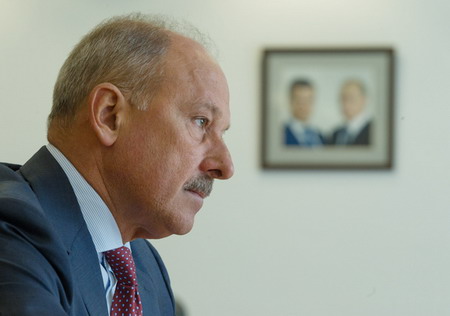
Almost two years ago in his interview to Vedomosti Vladimir Dmitriev said that VEB was ceasing to tackle the crisis and starting to operate on its own as a development institution. He expected that the state corporation would be able to triple its loan portfolio without being funded from the budget. Eventually, the loan portfolio grows at required rates but VEB is again in need of budgetary support “There are grounds for being moody because VEB is being used as a quasi-budgetary instrument”, says Dmitriev and tells what he likes and what he does not like in the way his Bank operates and is being used by the state.
- VEB’s strategy until the year 2015 was approved and provides for its loan portfolio to grow ambitiously. Will you be able to implement these plans and aren’t you going to adjust them, given the current economic situation?
|
Biography Born in 1953. Graduated from the Moscow Finance Institute, specialty – “International Economic Relations”. |
|
1987 Second, first secretary, Embassy of the USSR, Russia in Sweden. |
|
1995 Deputy Chief Executive Officer, Russian Finance Ministry Department of Credits and Foreign Debt. |
|
2002 Bank for Foreign Trade of the USSR. Deputy Chairman of the Board. In 2002, was appointed as Board Chairman of the Russian Commercial Bank (Cyprus), Vneshtorgbank’s subsidiary bank. |
|
2004 Bank for Foreign Economic Affairs of the USSR, Chairman. |
|
“We didn’t find all its skeletons right away.” VEB has a bank in Ukraine - Ukraine’s Prominvestbank. According to Dmitriev within a month they’ll additionally capitalize it for an amount of 350 million dollars. The bank needs additional resources to address the problem of bad credits it received from the former management. “The situation in Ukraine is pretty unfavorable including problems with repayment of debts but they manage to get some debts repaid,” says Dmitriev. “Some fail to repay a credit referring to personal connections; others just don’t want to pay. And then some say they are ready to take debts through paying 10% of their par value.” According to Dmitriev a decision to purchase the bank in Ukraine was “political”. “At that time the bank was on its way to bankruptcy, its potential was strong. But unfortunately we didn’t find all its skeletons right away and it proved to have more closets than we thought. In principle we bought this bank to work with major customers that had links with Russia”. Dmitriev says that the bank didn’t participate in making payments for gas. “The fact is that main contracting parties of Russian companies were served in this bank. Moreover deposits started to outflow from the bank, the situation posed a threat to the whole Ukrainian banking system and Russian banks operate there. By the way we bought the bank for 250 million dollars in November of 2008 and as early as in April Italians offered to the bank’s owners to buy it for 2.5 billion dollars. They refused because they thought it cost at least 4 billion dollars. The bank was controlled at the time by the former Chairman of Ukraine’s National Bank who privatized it out of hours”. |
|
Vnesheconombank Founder – the Government of the Russian Federation. Financial Indicators (IRFS, 2012): Assets - 2.9 trillion rubles Capital – 531.9 billion rubles Net profit – 17.5 billion rubles |
- Yes, we are. But before talking about our strategy we should talk about alarming signals in the economy. The President and the Prime Minister held several meetings on this issue. Key signals are reduction in economic growth rates. A real slump in production in some sectors, reduction in investments in fixed capital make us think hard about what additional measures VEB and its subsidiaries could take to support the state’s efforts to counter such negative trends.
- Have you drawn appropriate conclusions?
- We can see that VEB is not a panacea and the only development institution in the country but the Bank could play a crucial role in breakthrough sectors through its investments in the real economy. I’d like to highlight the following point: economists say that the growth in banks’ loan portfolios is enough to get the economy functioning normally. But if we open these portfolios, we’ll come up against a very interesting circumstance. In 2012, 1.5 trillion rubles were spent on M&A transactions with Russian assets. This is twice the amount of commercial banks’ credits for fixed capital renovation. This means that capital flows from one pocket to the other and investments are not made in the real economy. The economy does not get enough long-term money and this is a problem the state should concentrate on using VEB’s capabilities.
- We’ve just got back to the loan portfolio…
- We hope to bring it to 800 billion rubles by the end of the year and under our strategy it is to amount to 850 billion rubles by 2015. In 2012, our loan portfolio increased by 42%, I believe we’d be able to exceed the target of 850 billion rubles. To tell you the truth, there are two constraining factors in increasing our loan portfolio. The first is capital adequacy ratio of 10%, the second – borrowing limits. To be within the set limits we should either increase our loan portfolio or increase our capital base. As far as our capital base is concerned we are unfortunately limited by our profits. Budgetary funds are used in a targeted way to fund specific programs although we understand that this is caused by budgetary constraints.
- It appears that a question of the Bank’s capitalization will arise soon?
- Sooner or later. We haven’t brought it up so far but it will arise when we come up against the need to meet capital adequacy requirements.
- When might this happen and how much money might you need? And what do you hope for, given substantial budgetary constraints?
- We are working on this issue with the Finance Ministry but it’s too early now to give any specific figures.
- If you don’t give figures one might think that you are asking for a lot of money.
- We have some time till August when we’ll get to know about amendments to the budget. We are sure to discuss them.
- Are you happy with your loan portfolio composition? There are different opinions on this account including those that there are many projects in it which are not closely related to VEB’s objectives?
- There are grounds here for being moody because VEB is being used as a quasi-budgetary instrument.
- As a rescue team?
- In a way, as an emergencies ministry. In the case that something can’t be funded from the budget or problems emerge in some sectors, there is VEB that has to come to the rescue. I’m not naming any names. Commercial banks and other innovation institutions invested in innovative production facilities but their products proved to be in no demand, the global market moved in a different direction. And they are asking the Government to get VEB to replace their investments with its own. We also receive letters from regional leaders: there is a very good project, very important for the region’s development but VEB does not take a positive decision. We offer them to fund an engineering stage, make a model and conduct a feasibility study. They want us to provide them with money. I’m sure that given such an approach any commercial bank wouldn’t agree to fund their projects including banks with state participation.
- How often do you receive such requests?
- We receive them quite often. And those who turn to VEB for money often stress the importance of social issues. For example, a head of a region comes and says, “I have an election coming up and a new plant will employ 1000 people, do you care about national interests? I’ll file complaints against you”. Thankfully, we, the RF government office and the presidential Administration think in the same way, they explain to those who ask for money for what purpose VEB was established.
- Can you name the governors who visit you?
- There aren’t many of them and I’m not going to give their names.
- What do you think should be done to change this sort of approach? Maybe it makes sense to change your organizational and legal form and dilute state capital?
- The only thing we can do here is to educate them in the proper way. Nobody is going to change the Bank’s organizational and legal form. And the world practice shows that the state should be the sole owner of the Bank for Development. But we also should operate in accordance with our Memorandum without expanding our functions endlessly and without having to perform functions that prevent us from carrying out our development mission.
- The Chairman of the Central Bank is to be replaced soon, should a regulator stimulate economic growth and how? What’s your opinion?
- It should and the Central Bank does it but within its powers and competence, that is, through monetary policy. We can feel the effects of its policy, here I mean lending against pledge mechanisms. We are worried a lot about credit rates. They depend not only on the Central Bank although the regulator could influence them in a more active way through inflationary expectations. Elvira Nabiulina also understands this, but I don’t think that she will bring revolutionary changes to the Central Bank’s policy. And do we need them at all?
- Don’t you recommend to change basic rates including refinancing ones?
- Refinancing rates are not main benchmarks for banks. Repo rates are more important for them. On the other hand, bank margins amount to tens of percentage points in consumer lending. Even if we take large banks including those with state participation, their net percentage margin amounts to 7%. This is a problem we have to think over. Any large foreign bank could envy such a margin, with its profits being a lot higher than those in Russian banks. Our margin is about 2%.
- And how does it change from project to project?
- It doesn’t change from 1.5% in one project to 10% in the other, it is about 2% and it changes within this range. As far as Olympic projects are concerned our benchmark is refinancing rate plus 0.4-1.6%.
- What projects are you interested in? What are your priorities now? For example, the Far East?
- In terms of development of territories there are three lines of activity: the Far East, the North Caucasus and Kaliningrad. And we are also going to go ahead vigorously with our core projects, which can bring about a technological breakthrough. These projects are in such sectors as space, information technologies, biomedicine and aviation industry.
- The Government places great hopes on TIF investment mechanism which provides for a return of investments through future taxes. What role will VEB play in this mechanism?
- The idea is that a private investor creating infrastructure synchronizes its action with an industrial investor which builds a production facility on this infrastructure. Additional taxes received from the project and comprehensive development of territories are to be then returned to investors. Here VEB can act as an investment consultant, prepare documents for lenders, raise funds to finance a project and help pay for pre-project work. There are many options for participating in such projects but it’s important to analyze and assess them properly.
- What projects are they? And why is it important to analyze them properly?
- The problem is that sometimes they tell us about projects worth 10 trillion rubles and 90% of them are not even applications but just ideas. And this is not the only problem. So far we have failed to understand how to synchronize functioning of local, regional and federal budgets with regard to TIF. For example, a comprehensive housing development project in the city of Kirov: 80% of expenses on infrastructure is incurred by the municipality but the local budget and the region receive only 20% of new tax revenues. So, as Alexandr Livshits said, the federal budget here should share taxes with local budget and regions.
- I know that another new investment mechanism is under discussion. Under this mechanism an investor entering into a complicated project together with the Russian Direct Investment Fund can receive debt financing from VEB to pay its share.
- So far the Russian Direct Investment Fund (RDIF) have participated in implementing projects with financial investors, for example, in the field of medicine, they took part in the “Mother and Baby” project. If RDIF comes to us and says it has an industrial investor in the greenfield, let’s work out a scheme together to provide a project both with share and borrowed capital and this doesn’t run counter to our Memorandum at all. I know that RDIF has several such greenfield investors in its pipeline and we’ll work together on searching attractive transactions for them.
- VEB is a main creditor of Olympic facilities construction. Will they be built in due time? Do you expect credits to be repaid?
- We have already extended credits worth 110 billion rubles till the end of the year the amount of credits will be about 220 billion rubles. As far as construction periods are concerned construction schedules are realistic, the construction will be completed by the Olympics. It’s also no secret that according to our estimates a significant part of projects is estimated to be unprofitable. Given the current model and market conditions we have serious problems with recoupment of investments. For example, in the Imereti Lowland one million square meters of hotels are being built. When the hotels are put on the market after the Olympics, it will be difficult to bring occupancy rate even to 60%. Many projects got a lot more expensive in the course of their implementation because of technological changes or strict environmental standards. We have no full project documentation on many projects, there are no confirmed cost estimates – all this confirms our doubts.
- Are there any projects that pose no problems?
- We have no doubts about the future of the Sochi thermal power station; the airport doesn’t pose any serious problems. But the situation is pretty tense with sports projects. As far as repayment of credits is concerned we received guarantees from all investors that in the case that problems emerged after the Olympics they would resolve them using their own funds. We have received guarantees from Olympstroy but these are budgetary funds and we really care about their future.
- You are the Board Chairman of the United Aircraft Construction Corporation (UACC), how do you size up the Corporation development strategy?
- At our last meeting of the Board of Directors we discussed the management’s report on the Corporation’s performance for 2012, the dynamics is positive. We – I mean the Board of Directors expect the Corporation to operate on a breakeven basis by 2015. Of course here government defense orders and advance payments on supplies play a very important role but not only they play such a role. The proportion of civil aircraft in UACC total sales in 2012 tripled and amounted for the first time to 10%. Governance of the Corporation’s structures is consolidated according to “one window” principle. This is not the case now when individual plants took unsecured credits at enormous interest rates from poorly known banks. And the strategy remains the same – it is aimed at creating a range of aircraft that are competitive not only in Russia but also abroad, above all in the countries where we haven’t lost our positions.
- To what extent is it true that you can surrender your position as Board Director to Sergei Chemezov and that Mikhail Pogosyan might resign?
- There is much talk. Sergei Chemezov and I as an independent director were nominated by the state to the Board of Directors, voting is to be held at the upcoming shareholders’ meeting. As to a position of director general a decision on it is to be taken in a collegial way. I for one and I think my colleagues have no reasons to question Mikhail Pogosyan competence. I haven’t heard about other candidates for a position of director general.
- The crisis left VEB with three banks. Are you going to sell or develop them?
- We are just finishing work on formulating a strategy, above all, with regard to Globex and Svyaz-Bank. 80% of work has been already done. A sale of banks to a strategic partner or through IPO is a distant prospect. We should prepare the banks’ assets for sale as we took the banks on our balance sheet. They have god assets for example Globex has Novinsky Passage and a shopping center in Novosibirsk.
- So, you are going to develop them?
- Yes, we are. In terms of strategy these banks are universal but each with its niche. Globex gives high priority to corporate customers although it also works with natural entities and is even involved in mortgage lending. Svyaz-Bank works with communications companies and with the Post of Russia on pension accounts. It’s also involved in military mortgage lending which is in the focus of our attention. The Bank accounts for the fourth of military mortgage lending market and is going to retain its position. We’ll capitalize both banks through entering into their capital directly and subordinated loans.
- We’ve just moved to the post. What happened to the idea of establishing a Postal Bank? They say that Alexandr Kiselev was against the idea but he’s left now.
- I don’t know to what extent he was against the idea. But necessary conditions for establishing a Postal Bank have not been created. They include transforming the Post of Russia into a joint stock company and agreeing upon a question of how the Post of Russia should be funded to purchase shares of a new bank.
- What stake can be sold to the Post of Russia?
- It’s a matter of independent valuation that nobody hasn’t made yet. The Post of Russia has made its own valuation and announced an unacceptably high price. And in the course of the discussion the Post of Russia stepped up its financial activity and entered into agreements with almost 30 banks. And it became possible to offer credit services to people through post offices. The idea is now put in cold storage. I don’t think that it is dead but there are no necessary conditions for pushing it forward and such investors as Nomos-Bank and Russky Standard appear to have become indifferent to the idea.
- Do you personally support the idea?
- I don’t see anything bad in pushing it forward.
- Alexandr Lebedev told you that he could buy out real property of Globex. Do you favor his proposal?
- We have never considered it seriously. We do not regard newspaper publications as offers. Lebedev has never made a real proposal.
- There is another “crisis bank” – Ukraine’s Prominvestbank. What do you plan to do with it?
- We plan to further develop it. Within a month we’ll additionally capitalize it for an amount of 350 million dollars. The bank needs additional resources to address the problem of bad credits it received from the former management. The situation in Ukraine is pretty unfavorable including problems with repayment of debts but we manage to get some debts repaid. Some fail to repay credits referring to personal connections; others just don’t want to pay. And then some say they are ready to take debts through paying 10% of their par value. The bank is among the largest six banks in Ukraine and is one of the most reliable banks. We have no complaints against its management. Now we are developing a mechanism for transferring to making regional payments in rubles.
- What did you purchase this bank for?
- A political decision was made. At that time the bank was on its way to bankruptcy, its potential was strong. But unfortunately we didn’t find all its skeletons right away and it proved to have more closets than we thought. In principle we bought this bank to work with major customers that had links with Russia.
- Some say the bank participated in making payments for gas.
- This is not the case. The fact is that main contracting parties of Russian companies were served in this bank. Moreover, deposits started to outflow from the bank, the situation posed a threat to the whole Ukrainian banking system and Russian banks operate there. By the way we bought the bank for 250 million dollars in November of 2008 and as early as in April Italians offered to the bank’s owners to buy it for 2.5 billion dollars. They refused because they thought it cost at least 4 billion dollars. The bank was controlled at the time by the former Chairman of Ukraine’s National Bank who privatized it out of hours.
- Did you discuss an idea that VEB would take Rosselkhozbank’s problem assets worth 150 billion rubles on its balance sheet? Are you still discussing this idea?
- No, we are not.
- In 2010-2011, VEB bought from E.On ADR 2.7% of Gazprom’s capital for an amount of more than 100 billion rubles. Now the stake got a lot cheaper. What do you propose to the Government to do with it?
- Since its purchase its price fell 30%. So, we didn’t make any proposals leading to losses (that is about a sale) to the Government. We’ll wait until its price grows. But it’s not only a matter of price. VEB’s 3.6% stake allows the state to control the company.
- At some point the stake’s price was higher, were you offered to sell it then?
- Yes, we were. If we had sold the stake in April of 2012, we would have made a profit of 30 billion rubles. But at that time VEB’s Supervisory Board believed that it made no sense to lose the asset.
- Are you interested in buying the BAT-Yava factory? If you are, what are your plans for the plant?
- Yes, we are but only in connection with Slava facility which we received in the course of rehabilitating Globex. BAT-Yava is next door to Slava. We are going to build hotel-office buildings there including living apartments and there is a tobacco factory nearby and it smokes. So, it’s easier to buy out the asset and develop the territory in a comprehensive way.
- How much are you ready to pay? Have you already made a proposal?
- I for one haven’t discussed this issue with BAT-Yava’s owners.
- VEB approved a credit worth 60 billion rubles up to the year 2020 to AvtoVAZ. Has the plant started to use the funds and what projects are they going to fund with them?
- So far, we have a decision concerning limits. Now we are examining individual projects comprehensively, these are modernization designed to produce a new rage of cars, expansion of production including a purchase of equipment and retooling of shops.
- What other projects do you have in the automotive industry, are you to extend credits to other players?
- We have quite a few projects in the automotive sector. To some extent we cooperate with Russian key players. Our key partner is FordSollers and Sollers’ projects in the Far East. As to them we are funding three production facilities including assembly, manufacturing of engines and components. We are also working with GAZ Group specifically on a project in Yaroslavl (the Yaroslavl engine plant). But these are not new credits, all the decisions were already made.
- Did the crisis in Cyprus affect VEB or your customers?
- It didn’t affect our bank at all, we are not working with the Bank of Cyprus and Laiki. We make interbank payments with the Russian Commercial Bank, we didn’t have any problems with it. Now we are conducting inventory auditing to see how the Cypriot crisis affected our customers. We haven’t seen any worrying signals so far.
- How do you feel about accusations against Anatoly Ballo over the alleged abuse of office in connection with a 14 million dollar credit to Eurasian?
- Recently the Presidium of the Moscow City Court made a ruling that a criminal case against Anatoly Ballo had been opened illegally and sent the case materials for a new consideration. This says a lot about the case. No damage was caused to the Bank, the credit was repaid. Criminal cases were closed with regard to two suspects.
- Can you comment the situation with Zarechye-2?
- In 2006, Vnesheconombank extended a credit to LLC Zarechye-2 for the construction of a residential compound in the Odintsovo district of the Moscow region. At present, the project has not been carried out and there is a threat that the credit will not be repaid. Vnesheconombank informed LLC Zarechye-2 repeatedly that it must fulfill its obligations under the credit agreement. Considering that the borrower failed to fulfill a number of obligations under the credit agreement Vnesheconombank demanded the borrower to repay the credit worth 170 million dollars. Later on Vnesheconombank appealed to an arbitration court to protect its interests. Moreover, as a result of conducting construction and financial-accounting examinations on the Bank’s initiative, facts of credit funds embezzlement were revealed. In relation to this Vnesheconombank appealed to law enforcement authorities requesting them to check if the credit was used properly and open a criminal case against officials of Zarechye-2 and its beneficiaries over the facts of monetary funds embezzlement. The State Corporation intends to take all legal actions to protect its interests.
- Why did you decide to rebrand VEB?
- We decided to rebrand not only Vnesheconombank but also the whole of Vnesheconombank Group being aware that we’ll be together for a long time. So, visual representation should not be associated with old symbols and be in line with an image of the National Bank for Development. The current brand is outdated. Moreover, Vnesheconombank Group is composed of various companies; they have different stylistics and position themselves differently. All this creates obstacles to communication and makes it difficult to get a realistic picture about VEB Group’s activity as a whole and opportunities our subsidiaries open up for Russian business. We hope to use synergy of all participants in Vnesheconombank Group in order to create strong brand – VEB. As to transferring to laconic abbreviation – VEB, its new graphic presentation and its new company style will be recognizable, modern and dynamic. And abbreviation VEB has been used for many years by us and the mass media.
Back
[Bitrix\Main\DB\SqlQueryException]
Mysql query error: (1290) The MySQL server is running with the --read-only option so it cannot execute this statement (400)
REPLACE INTO b_iblock_section_iprop (IBLOCK_ID, SECTION_ID, IPROP_ID, VALUE) VALUES ('4', '7290', '80', 'News')
/var/www/veb/data/www/veb.ru/bitrix/modules/main/lib/db/mysqliconnection.php:137
#0: Bitrix\Main\DB\MysqliConnection->queryInternal(string, array, NULL)
	/var/www/veb/data/www/veb.ru/bitrix/modules/main/lib/db/connection.php:330
#1: Bitrix\Main\DB\Connection->query(string)
	/var/www/veb/data/www/veb.ru/bitrix/modules/iblock/lib/inheritedproperty/basevalues.php:224
#2: Bitrix\Iblock\InheritedProperty\BaseValues->insertValues(string, array, array)
	/var/www/veb/data/www/veb.ru/bitrix/modules/iblock/lib/inheritedproperty/sectionvalues.php:146
#3: Bitrix\Iblock\InheritedProperty\SectionValues->queryValues()
	/var/www/veb/data/www/veb.ru/bitrix/modules/iblock/lib/inheritedproperty/basevalues.php:104
#4: Bitrix\Iblock\InheritedProperty\BaseValues->getValues()
	/var/www/veb/data/www/veb.ru/bitrix/components/bitrix/news.list/component.php:276
#5: include(string)
	/var/www/veb/data/www/veb.ru/bitrix/modules/main/classes/general/component.php:594
#6: CBitrixComponent->__includeComponent()
	/var/www/veb/data/www/veb.ru/bitrix/modules/main/classes/general/component.php:653
#7: CBitrixComponent->includeComponent(string, array, NULL)
	/var/www/veb/data/www/veb.ru/bitrix/modules/main/classes/general/main.php:1037
#8: CAllMain->IncludeComponent(string, string, array)
	/var/www/veb/data/www/veb.ru/local/templates/.default/components/bitrix/news/press-tsent/bitrix/news.detail/.default/template.php:288
#9: include(string)
	/var/www/veb/data/www/veb.ru/bitrix/modules/main/classes/general/component_template.php:720
#10: CBitrixComponentTemplate->__IncludePHPTemplate(array, array, string)
	/var/www/veb/data/www/veb.ru/bitrix/modules/main/classes/general/component_template.php:815
#11: CBitrixComponentTemplate->IncludeTemplate(array)
	/var/www/veb/data/www/veb.ru/bitrix/modules/main/classes/general/component.php:735
#12: CBitrixComponent->showComponentTemplate()
	/var/www/veb/data/www/veb.ru/bitrix/modules/main/classes/general/component.php:683
#13: CBitrixComponent->includeComponentTemplate()
	/var/www/veb/data/www/veb.ru/bitrix/components/bitrix/news.detail/component.php:438
#14: include(string)
	/var/www/veb/data/www/veb.ru/bitrix/modules/main/classes/general/component.php:594
#15: CBitrixComponent->__includeComponent()
	/var/www/veb/data/www/veb.ru/bitrix/modules/main/classes/general/component.php:653
#16: CBitrixComponent->includeComponent(string, array, object)
	/var/www/veb/data/www/veb.ru/bitrix/modules/main/classes/general/main.php:1037
#17: CAllMain->IncludeComponent(string, string, array, object)
	/var/www/veb/data/www/veb.ru/local/templates/.default/components/bitrix/news/press-tsent/detail.php:70
#18: include(string)
	/var/www/veb/data/www/veb.ru/bitrix/modules/main/classes/general/component_template.php:720
#19: CBitrixComponentTemplate->__IncludePHPTemplate(array, array, string)
	/var/www/veb/data/www/veb.ru/bitrix/modules/main/classes/general/component_template.php:815
#20: CBitrixComponentTemplate->IncludeTemplate(array)
	/var/www/veb/data/www/veb.ru/bitrix/modules/main/classes/general/component.php:735
#21: CBitrixComponent->showComponentTemplate()
	/var/www/veb/data/www/veb.ru/bitrix/modules/main/classes/general/component.php:683
#22: CBitrixComponent->includeComponentTemplate(string)
	/var/www/veb/data/www/veb.ru/bitrix/components/bitrix/news/component.php:216
#23: include(string)
	/var/www/veb/data/www/veb.ru/bitrix/modules/main/classes/general/component.php:594
#24: CBitrixComponent->__includeComponent()
	/var/www/veb/data/www/veb.ru/bitrix/modules/main/classes/general/component.php:653
#25: CBitrixComponent->includeComponent(string, array, NULL)
	/var/www/veb/data/www/veb.ru/bitrix/modules/main/classes/general/main.php:1037
#26: CAllMain->IncludeComponent(string, string, array)
	/var/www/veb/data/www/veb.ru/en/press-center/index.php:6
#27: include_once(string)
	/var/www/veb/data/www/veb.ru/bitrix/modules/main/include/urlrewrite.php:159
#28: include_once(string)
	/var/www/veb/data/www/veb.ru/bitrix/urlrewrite.php:2